
|
Print address label, cards and more.
Get data from MS Excel, MS Access and print on your labels! |
|





|
||
Take Video Tutorials for our products to find out most of your answers. It is a step by step guide to show you how you can do most of work. It's easy, it's fun, just click and watch!
Some Questions and Answers - May help you!

- What payment options are available?
- What currencies do you accept?
- How can I place an order?
- What will happen after I place my order?
- When will I receive my product?
- How do I get any special discounts?
- How can I place a purchase order?
- How will the charge appear on my credit card /debit card statement?
- Can I get the product on a CD-ROM?
- When will I receive my CD-ROM on Demand?
- What will I receive if the product is delivered by e-mail?
- How secure is my online order?
- Will my personal data be shared with any third parties?
- Can I save my card as PDF file or Image file?
- I see a slight misalignment while printing. What are the other ways to print?
- How do I add/remove back side of my card?
- How do I print back side of my card?
- Why do the shadows not show up even if I choose 'show shadow' on the properties window?
- Can I create a vertically aligned card or a custome size business card?
- I choose a background color, but doesn’t show up. Why?
- I saved my design as a template, but does not show up in the "New Card Template" window. What's wrong?
- I closed the property window. How do I get it back for changing the properties(color, size, tilt angle etc.) of an element?
- How can I send my design to someone by email who does not have this software?
- How do I use new font with the application?
- I cannot move or resize some elements in my design. Why?
- I have some elements that are outside the design area. Will they show up on my printed card?
- What graphic file formats are supported by Belltech Business Designer Pro?
- How do I use an image file that is in an unsupported format?
- What type of paper do I buy to print business cards?
- 'Save as Image' does not save the background image. How do I do it?
- I would like to save my card as a high resolution image and then get it printed from a printshop. How can I do this?
- After entering text or in print i see dots appearing, not the whole text. How can I fix this?
- How can i add ©, ®, TM, bulletted item list or other symbols?
- How do I change the size of a photo or text or any element?
- How do I use my letterhead with Microsoft Word document?
- How do I print a list of name badges on the same page?
- I closed the property window. How do I get it back for changing the properties(color, size, tilt angle etc.) of an element?
- How can I send my design to a printshop for professional printing?
- How do I use new font with the application?
- How do I use an image file that is in an unsupported format?
- How do I print only one label at a specified location on my sheet?
- How do I connect to my data files?
- What types of data files are supported?
- I want to print address labels from my Excel files. Do I need to know SQL?
- How do I convert my date to format like January 5, 2005 or 01/05/2005 etc.?
- How do I join 2 fields into one. Like FirstName, LastName into one single line, or Addrs1, addrs2 into one field?
- How do I add automatic label counter, like 1 of 100, 2 of 100 or 1/100 ?
- How can I pull data from 2 or more sheets from a single Excel file?
- How do I connect to my data files, Access or Excel sheet?
Please refer to CaptureXT help pages.
Index Of Barefoot 2014 -
It seems you are looking for a
However, after extensive cross-referencing across economic databases (World Bank, UN, IMF), financial indices (S&P, MSCI, FTSE), and cultural archives,
The "Barefoot 2014 Index" refers not to a stock market ticker but to a used by the Barefoot College to evaluate its three decades of work. By 2014, the College had trained over 1,000 grandmothers from 78 countries as solar engineers. The Index for that year became a landmark case study in alternative economics, proving that illiterate, rural women could outperform Western engineers in sustaining off-grid solar power. The Three Pillars of the 2014 Index Unlike conventional indexes (e.g., the Human Development Index or Dow Jones), the Barefoot 2014 Index measured success across three unconventional metrics: 1. The Solar Grandmother Coefficient The core data point of the 2014 Index was the number of solar engineers trained who returned to electrify their villages . In 2014 alone, the College graduated 214 women from 21 African, Asian, and Pacific nations. Their average age was 55; 98% were illiterate; and 100% had never traveled by airplane before arriving in India. The Index tracked not just graduation but retention —and the 2014 data showed a 97% success rate of these women maintaining solar panels 5+ years post-training. 2. The Carbon Offset per Capita Barefoot College calculated that each solar grandmother electrifies approximately 100 households. By 2014, cumulative installation of 15,000 household systems displaced an estimated 90,000 liters of kerosene per day. The Index computed a CO2 reduction of 1.2 million tons over the lifetime of the 2014 cohort’s installations. This was more efficient per dollar than most UN Clean Development Mechanism projects. 3. The Dignity Dividend The most controversial metric in the 2014 Index was qualitative: the rise in women’s decision-making power. Surveys conducted in 2014 across 300 villages in Bhutan, Malawi, and Colombia showed that in households with a Barefoot solar engineer, girls’ school attendance rose by 40% and reported domestic violence dropped by 26%. The Index labeled this the "Dignity Dividend"—an unquantifiable but undeniable return. Case Study: The Gambia Cohort (2014) A flagship entry in the 2014 Index was the training of 12 women from rural Gambia. These grandmothers, none of whom could read a label in English, learned to solder circuit boards using color-coded diagrams (blue wire to blue dot, red to red). Within six months, they returned to villages that had never seen electricity. By December 2014, they had installed 1,200 solar home systems. The Index recorded that for the first time, children in these villages could study after sunset, and health clinics could refrigerate vaccines. Why "2014" Matters: The Shift from Pilot to Movement The 2014 Index was pivotal because it marked the first year Barefoot College moved from anecdotal evidence to rigorous, audited data. Prior to 2014, donors demanded literacy as a prerequisite for funding. The 2014 Index proved otherwise: illiteracy was not a barrier to high-tech proficiency . This finding directly challenged the World Bank’s 2013 "Education for All" metrics, which assumed basic literacy was necessary for technical training.
It is highly probable you are referring to one of the following three concepts. Below is a detailed, long-form article for the most likely candidate: , followed by brief notes on the other possibilities. The 2014 Index of Impact: How Barefoot College Redefined Development Metrics Introduction: Beyond GDP in a Rajasthani Village In September 2014, while world leaders gathered at the UN Climate Summit in New York to discuss top-down carbon credits and cap-and-trade systems, a very different kind of metric was being recorded 4,000 miles away in Tilonia, Rajasthan. At the Barefoot College, founded by social innovator Bunker Roy, a quiet revolution was being quantified. This was the year the organization published its most comprehensive internal "Index of Impact"—not measured in dollars or megawatts, but in lives lit, women empowered, and villages decarbonized.
It seems you are looking for a
However, after extensive cross-referencing across economic databases (World Bank, UN, IMF), financial indices (S&P, MSCI, FTSE), and cultural archives,
The "Barefoot 2014 Index" refers not to a stock market ticker but to a used by the Barefoot College to evaluate its three decades of work. By 2014, the College had trained over 1,000 grandmothers from 78 countries as solar engineers. The Index for that year became a landmark case study in alternative economics, proving that illiterate, rural women could outperform Western engineers in sustaining off-grid solar power. The Three Pillars of the 2014 Index Unlike conventional indexes (e.g., the Human Development Index or Dow Jones), the Barefoot 2014 Index measured success across three unconventional metrics: 1. The Solar Grandmother Coefficient The core data point of the 2014 Index was the number of solar engineers trained who returned to electrify their villages . In 2014 alone, the College graduated 214 women from 21 African, Asian, and Pacific nations. Their average age was 55; 98% were illiterate; and 100% had never traveled by airplane before arriving in India. The Index tracked not just graduation but retention —and the 2014 data showed a 97% success rate of these women maintaining solar panels 5+ years post-training. 2. The Carbon Offset per Capita Barefoot College calculated that each solar grandmother electrifies approximately 100 households. By 2014, cumulative installation of 15,000 household systems displaced an estimated 90,000 liters of kerosene per day. The Index computed a CO2 reduction of 1.2 million tons over the lifetime of the 2014 cohort’s installations. This was more efficient per dollar than most UN Clean Development Mechanism projects. 3. The Dignity Dividend The most controversial metric in the 2014 Index was qualitative: the rise in women’s decision-making power. Surveys conducted in 2014 across 300 villages in Bhutan, Malawi, and Colombia showed that in households with a Barefoot solar engineer, girls’ school attendance rose by 40% and reported domestic violence dropped by 26%. The Index labeled this the "Dignity Dividend"—an unquantifiable but undeniable return. Case Study: The Gambia Cohort (2014) A flagship entry in the 2014 Index was the training of 12 women from rural Gambia. These grandmothers, none of whom could read a label in English, learned to solder circuit boards using color-coded diagrams (blue wire to blue dot, red to red). Within six months, they returned to villages that had never seen electricity. By December 2014, they had installed 1,200 solar home systems. The Index recorded that for the first time, children in these villages could study after sunset, and health clinics could refrigerate vaccines. Why "2014" Matters: The Shift from Pilot to Movement The 2014 Index was pivotal because it marked the first year Barefoot College moved from anecdotal evidence to rigorous, audited data. Prior to 2014, donors demanded literacy as a prerequisite for funding. The 2014 Index proved otherwise: illiteracy was not a barrier to high-tech proficiency . This finding directly challenged the World Bank’s 2013 "Education for All" metrics, which assumed basic literacy was necessary for technical training.
It is highly probable you are referring to one of the following three concepts. Below is a detailed, long-form article for the most likely candidate: , followed by brief notes on the other possibilities. The 2014 Index of Impact: How Barefoot College Redefined Development Metrics Introduction: Beyond GDP in a Rajasthani Village In September 2014, while world leaders gathered at the UN Climate Summit in New York to discuss top-down carbon credits and cap-and-trade systems, a very different kind of metric was being recorded 4,000 miles away in Tilonia, Rajasthan. At the Barefoot College, founded by social innovator Bunker Roy, a quiet revolution was being quantified. This was the year the organization published its most comprehensive internal "Index of Impact"—not measured in dollars or megawatts, but in lives lit, women empowered, and villages decarbonized.
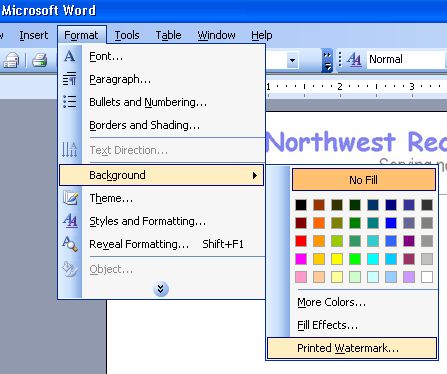
2.Open MS Word(*.doc)
3.In Word Doc, go to menu: Format->Background->Printed Watermark
4.Select a the letterhead image that you saved in step 1.
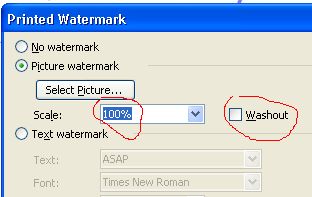
5.Choose scale 100% and uncheck Washout option. Click OK. You are done.

Q. How do I print a list of name badges on the same page?
Senario-1: You want to print multiple badges with different names.
Solution:
1. You must first have the list of names in a text file or Excel sheet or in a database file.
2. Then you need to connect your datafile as shown here - data connection
If you don't know how to create the txt/csv/xls file, check out these samples:
a. data in plain text file - sample-name-address.txt
b. data in Excel sheet - sample-name-address.xls
c data in csv file - sample-name-address.csv
Senario-2: You want to print multiple badges with same names.
Solution:
Just design one badge and then go to File->print menu and select how many you want to print.
Q. I closed the property window. How do I get it back for changing the properties(color, size, tilt angle etc.) of an element?
Q. How can I send my design to a printshop for professional printing?
Q. How do I use new font with the application?
Q. How do I use an image file that is in an unsupported format?
Q. How do I connect to my data files?
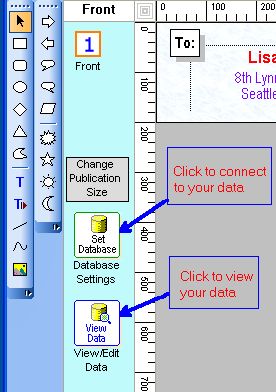
You can also click on menu: File-->Database Settings to set up your data files.
Then go to menu: Insert-->Text From Database to insert a text.
Q. I want to print address labels from my Excel files. Do I need to know SQL?
For most cases SQL knowledge is not required.
Steps to use excel data source:
1. Click on menu: File->Database settings. A Datasource Window appears.
2. Select excel option and browse to your excel file.
3. Now you will see a dropdown with all the excel sheets in the excel file.(an excel file may have one or many sheets)
4. Select the execl sheet you want from the dropdown.
5. Click ok.
At this point you have connected to your excel sheet with your work.
Now go to menu: insert->text from database, and insert an element to your design work. Then go to righthand side's properties area and see a drop down with all the columns in your selected excel sheet. Choose one column and you are done.
Then take a printpreview from file menu.
Q. How do I print only one label at a specified location on my sheet?
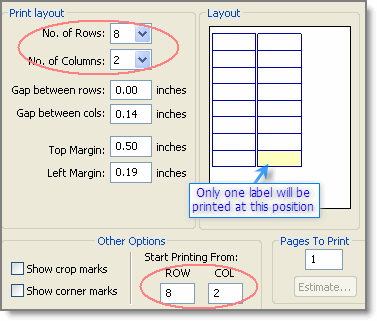
Then you choose this option in print window:
No. of rows=8
No. of cols=2
Start printing from row=8, col=2.
See illustrated image. The postion marked yellow will only be printed.
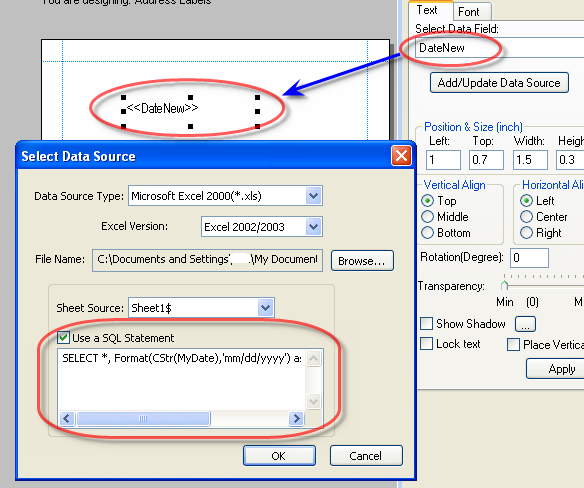
Q. How do I convert my date to format like January 5, 2005 or 01/05/2005 etc.?
SELECT * Format(CStr(MyDate),'mmmm dd, yyyy') as DateNew FROM [Sheet1$]
[This will convert the date to this format: January 5, 2005]
SELECT Format(CStr(MyDate),'mm/dd/yyyy') as DateNew FROM [Sheet1$]
[This will convert the date to this format: 01/05/2005]
You can use many other format strings like Format(CStr(MyDate),'m/d/yy'), Format(CStr(MyDate),'m-d-yy'),Format(CStr(MyDate),'mm-dd-yyyy') etc. Put the SQL statement in the text box as show below:
Q. How do I join 2 fields into one. Like FirstName, LastName into one single line, or Addrs1, addrs2 into one field? index of barefoot 2014
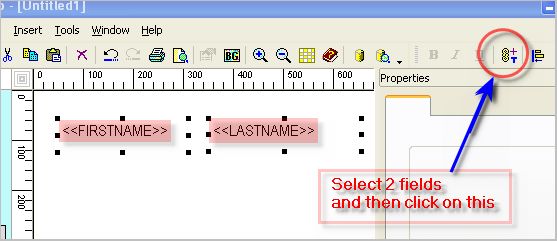
Step 1:
Select the 2 fileds(example FirstName, LastName) you want to join by holding "Ctrl" Key and clicking on them.
Step 2:
Then click on the tool button as shown, or select from menu: Tools->Merge selected DB-Texts Select
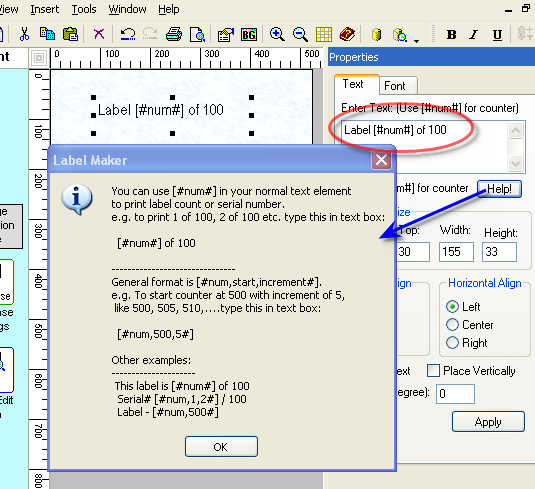
Q. How do I add automatic label counter, like 1 of 100, 2 of 100 or 1/100 ?
SELECT [SheetName$].Name, [SheetAddress$].Address FROM [SheetName$] , [SheetAddress$] where [SheetName$].ID=[SheetAddress$].ID
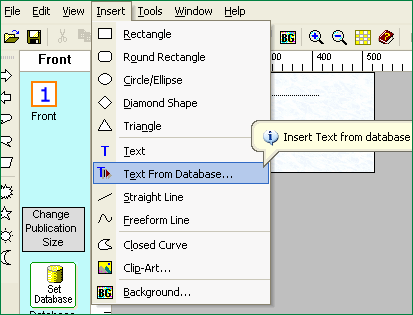
Q. How do I connect to my data files, Access or Excel sheet?
Click on menu: File-->Database Settings to set up your data files.
Steps 2:
Then go to menu: Insert-->Text From Database to insert a text as shown.
 It seems you are looking for a However,
Steps 3:
Then click on the text. You will see "<<TextFromDB>>" .
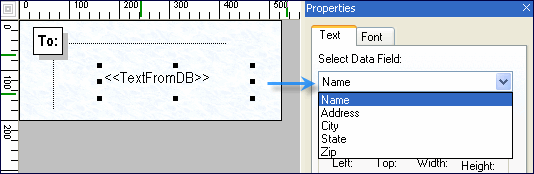
After that you will see a dropdown in the properties area. In the dropdown you will see all the columns
that your Access Table or Excel Sheet has. Select the column(e.g. Name) to show in this text element.
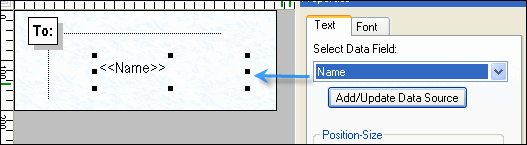
Steps 4:
Repeat step 2 and 3 to select other columns (e.g, Address, City etc.)
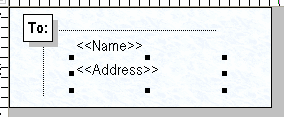
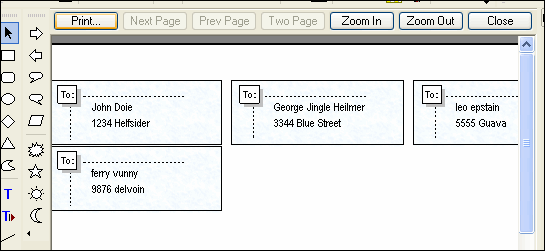
Steps 5:
Go to menu File->Print Preview to see a preview as shown.
If things look fine, print your labels.
 The Three Pillars of the 2014 Index Unlike
|
|
|
home %!s(int=2026) © %!d(string=Lively Modern Realm) | buy | products | services | support | privacy policy | |
|
Copyright © 2001-2009 Belltech Systems, Inc. All rights reserved
|