Secrets Of Mosfet Cross Reference and Replacement Guide
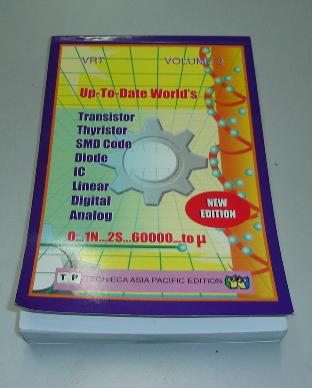
A Semiconductor Replacement Guide Searching for the right mosfet cross reference or datasheet, one has to look for a semiconductor transistor replacement data book and not the Philip ECG master replacement guide. Almost all the transistor replacement book will published out the specification of a particular components such as type of component it belong whether it is a fet, scr, bipolar transistor, horizontal output transistor and also the voltage, ampere, wattage, ohm, frequency and suggested substitution part number.
From my experienced, the substitution part number that was recommended by the data book is not always 100 % match. If you have the time, I would like to suggest to you that, find the right part number by yourself rather than depending on the transistor data book.
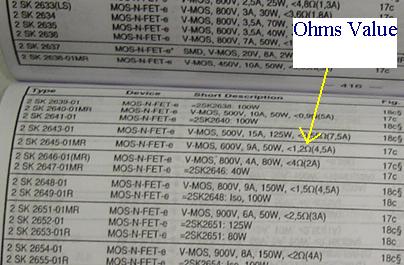
It is the same when you look for horizontal output transistor (HOT) specification which doesn't mean that the bigger specification, the better the substitution part number is. In searching for Mosfet cross reference, you have to look at the ohms value which is provided by the transistor data book besides the specification of voltage, ampere and the wattage. The replacement, besides the same or higher in voltage, ampere and wattage, one should also consider the ohms value. The ohms value has to be as close as possible.
Arrow is showing the mosfet ohms value in a transistor substituion book
If the original fet part number is 1 ohm then a good replacement mosfet must have the ohm values between of 0.5 to 1.5 ohm. Do not substitute it with a too high or too low ohms value as this will make the mosfet run warmer and eventually blow the mosfet itself. Even though you can get a replacement with a higher voltage, ampere and wattage, if the ohms value is too low or too high, the mosfet will still burnt after on for quite a while.
It runs well for sometimes before it breakdown again. After two weeks the customer brought back the printer with the same complaint which is no power. Upon checking the power side I found the same mosfet gave up again. Substituting with another mosfet part number that have a similar specification especially the ohms value solved the printer no power symptom.
Specification with larger voltage, ampere and wattage don’t guarantee that the replacement mosfet will work. So, taking the mosfet ohms value into consideration, you will have a higher chances to repaired the equipment and sometimes the replacement mosfet will also last longer.
|
|
Aptoide Apk Android 4.4.2 Download 2021 May 2026
Unlike the monolithic, server-side curated Google Play Store, Aptoide operates on a wiki-like model. Users can create their own "stores" and upload APKs, and the main Aptoide client aggregates these. In 2021, this structure proved uniquely advantageous for KitKat users. While Google had moved to requiring API level 21 (Android 5.0) for many new app uploads, the Aptoide community continued to host, test, and share APKs built for API level 19 (Android 4.4). Downloading the Aptoide APK itself—a lightweight installer of roughly 10-15 MB—was straightforward, requiring only that the user enable "Unknown Sources" in their security settings.
No essay on third-party APK stores would be complete without addressing security. Critics rightly note that Aptoide’s lack of a rigorous review process—unlike Google Play Protect—exposes users to potentially malicious forks of popular apps. In 2021, security researchers did indeed find adware and trackers in some Aptoide repositories. However, for the Android 4.4.2 user, this risk calculus was different. The device itself was no longer receiving security patches from its manufacturer. The operating system had known, unpatched vulnerabilities (such as Heartbleed or Stagefright). Using the Play Store would not fix these; only a custom ROM would. Therefore, for a user who simply wanted to turn an old phone into a dedicated music player or an e-reader, the convenience and functionality of Aptoide outweighed the marginal security risk—especially if they practiced basic hygiene (reading permissions, avoiding banking apps, and checking app signatures). Aptoide Apk Android 4.4.2 Download 2021
Once installed, Aptoide provided a functional, searchable catalog where the "minimum Android version" filter actually worked. In 2021, searching for "Firefox" or "VLC" on Aptoide would reliably return the last stable builds for Android 4.4.2, whereas the Play Store would simply refuse service. Aptoide did not promise the latest features; it promised compatibility. While Google had moved to requiring API level 21 (Android 5
By 2021, Android 4.4.2 KitKat was eight years old. While many budget and mid-range devices from 2014-2015 still functioned perfectly as media players, e-readers, or secondary phones, their operating systems were frozen in time. The official Google Play Services, which underpins app functionality and security, had largely ceased updating for KitKat. Consequently, when a user opened the Play Store on such a device, they were met with a wall of "Your device isn't compatible with this version" errors. Even lightweight apps like updated versions of Spotify Lite, Discord, or basic banking tools refused to install. The device was not broken; it was artificially gated. The standard solution—side-loading older versions of individual apps from archives like APKMirror—was tedious and inefficient. What users needed was a storefront that understood the limitations of Android 4.4.2, and that is precisely what Aptoide offered. Critics rightly note that Aptoide’s lack of a
The year 2021 is critical to this analysis. In 2018 or 2019, many major developers still supported KitKat. By 2022 and 2023, even third-party support had collapsed, as HTTPS certificate requirements and fundamental web standards outgrew the KitKat WebView. However, 2021 represented a twilight window: app developers had just begun dropping support, meaning the "last good versions" of thousands of apps were still circulating. Aptoide’s decentralized model captured this moment perfectly. Users were not downloading abandonware from sketchy forums; they were downloading community-verified APKs from a semi-respected storefront that had been in operation since 2009. For a few precious months, a Samsung Galaxy S4 or a Nexus 7 (2013) running Android 4.4.2 could still stream Netflix, browse Reddit, and play Angry Birds without complaint, all orchestrated via Aptoide.
Looking back from the mid-2020s, downloading the Aptoide APK for Android 4.4.2 in 2021 stands as a symbol of user agency against the tide of forced obsolescence. It was a pragmatic, if imperfect, solution to a real problem: a functional device being bricked by software policy, not hardware failure. Aptoide did not revolutionize the Android ecosystem in 2021, but for the niche community of KitKat holdouts, it provided a digital last stand. It proved that even as Google moved relentlessly forward, a decentralized, community-driven model could breathe a few more years of useful life into the devices millions of people still owned. In an era of throwaway technology, that was not just convenient—it was revolutionary.
Copyright@ 2006-2014-www.ElectronicRepairGuide.com All Rights Reserved