Basics


Info Download

Advanced

v/v
V
V

Plot Download

The primary goal of the Leonov's mission is to understand what happened to Discovery One and Bowman. The crew discovers a mysterious black monolith on Europa, one of Jupiter's moons, which seems to be sending a message to Earth. The movie explores themes of human existence, communication with possible extraterrestrial life, and the potential next step in human evolution.

"2010: The Year We Make Contact" is a thought-provoking science fiction film released in 1984. Directed by Peter Weir and written by Charles Russell and David L. Wolper, based on the novel by Arthur C. Clarke, the movie serves as both a sequel to Stanley Kubrick's "2001: A Space Odyssey" and a standalone exploration of humanity, technology, and extraterrestrial life.

The film explores deep philosophical and existential questions, reflecting on humanity's place in the universe and the potential for transcendence through technology and encounter with the unknown. While it did not achieve the same iconic status as its predecessor, "2010" was well-received for its thought-provoking storyline, visual effects, and the performances of its cast, particularly Gunter Lamprecht, David Warner, and Jude Wright.

Given this, I will create a report on the movie "2010: The Year We Make Contact" and conclude with some remarks on the provided technical specifications. Introduction

The film takes place nine years after the events of the first movie. The spaceship Discovery One, which was on a mission to Jupiter in "2001," has been recovered and is now headed back to Earth. The crew of the spaceship Leonov, a Soviet spacecraft, intercepts Discovery One. The Leonov's crew includes Commander Alexei Leonov, Dr. David Bowman (the sole survivor of the Discovery One mission who has been mysteriously aged to an older version of himself), and a few other cosmonauts.
Disclaimer: This tool is provided for educational and illustrative purposes only. No guarantee is made regarding accuracy, suitability, or performance. Use at your own risk. - Copyright: ufelectronics.eu / Andreas Dyhrberg

×
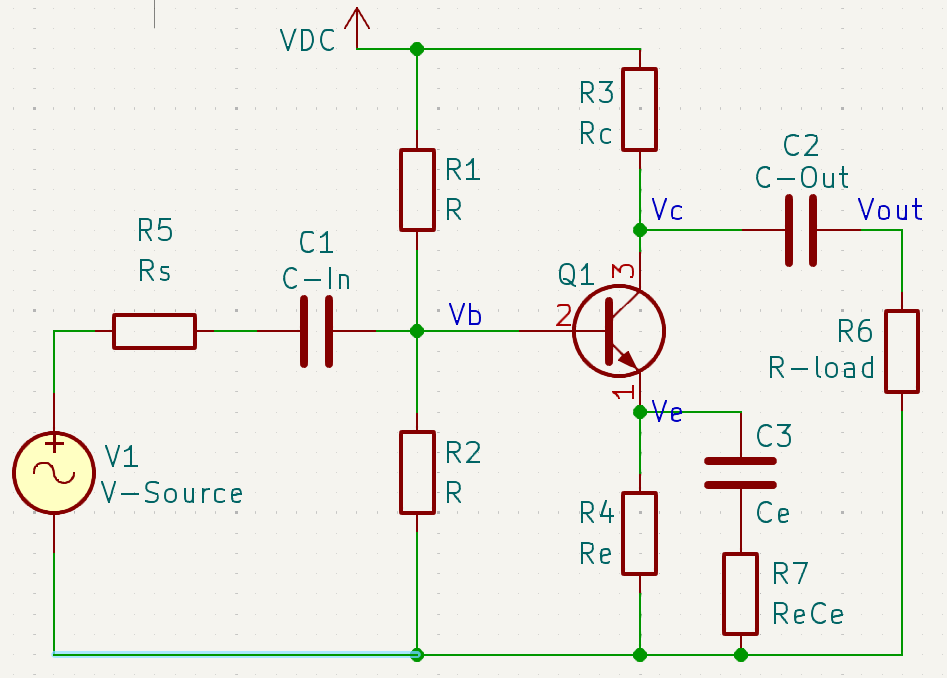
Amplifier Schematic
×

There are different ways to calculate an amplifier, depending on what you want to achieve.

Maybe you want to achieve a certain gain, as far as possible (classic mode). Or you have a low Vcc to respect (modern mode). Or you work with analog audio amps (symmetry mode).

Depending on what you want to achieve and the way of calculating it. Some fields might become dependent on others, or the other way around.

Your above choise makes some input fields available for manipulation, while hiding others.


🎯 1. Target Gain (Av) — "Classic mode" 2010 The Year We Make Contact -1984- 1080p ENG-...

You care about how much your amplifier multiplies the input signal.

Set desired voltage gain and Rc voltage drop. Best for learning and simple amplifiers.

You say: “I want a gain of 10.”
The app adjusts resistors to try and match that.
You must give Av and Vrc (the voltage dropped across Rc).

Best for common emitter amplifiers.

✅ Default choice for most beginners and educational use. The primary goal of the Leonov's mission is


⚡ 2. Target Emitter Voltage (Ve) — "Modern mode"

You care about setting a healthy DC bias point.

Prioritize stable biasing via Ve. Useful for low-voltage circuits or precision designs.

You say: “I want Ve = 0.5 V, to keep the transistor out of trouble.”
This makes sure your transistor stays in active mode.
Gain becomes whatever it turns out to be.

Ideal for common emitter amplifiers when the goal is to ensure proper biasing for low-voltage or precision circuits, and it’s also used in class AB amplifiers to prevent distortion "2010: The Year We Make Contact" is a

✅ Useful in low-voltage designs (e.g., 3.3V systems).


🧭 3. Target Collector Voltage (Vc) — "Symmetry mode"

You want to place the collector in the middle of the power rail.

Target Vc = Vcc/2 for maximum signal swing. Great for audio and analog signals.

You say: “Make Vc = Vcc/2” for maximum swing.
Useful for analog audio amps or symmetrical headroom.
Gain and Ve are outcomes.

Best for common collector amplifiers and class AB amplifiers.

✅ Best for signal integrity.

2010 The Year We Make Contact -1984- 1080p Eng-... File

The primary goal of the Leonov's mission is to understand what happened to Discovery One and Bowman. The crew discovers a mysterious black monolith on Europa, one of Jupiter's moons, which seems to be sending a message to Earth. The movie explores themes of human existence, communication with possible extraterrestrial life, and the potential next step in human evolution.

"2010: The Year We Make Contact" is a thought-provoking science fiction film released in 1984. Directed by Peter Weir and written by Charles Russell and David L. Wolper, based on the novel by Arthur C. Clarke, the movie serves as both a sequel to Stanley Kubrick's "2001: A Space Odyssey" and a standalone exploration of humanity, technology, and extraterrestrial life.

The film explores deep philosophical and existential questions, reflecting on humanity's place in the universe and the potential for transcendence through technology and encounter with the unknown. While it did not achieve the same iconic status as its predecessor, "2010" was well-received for its thought-provoking storyline, visual effects, and the performances of its cast, particularly Gunter Lamprecht, David Warner, and Jude Wright.

Given this, I will create a report on the movie "2010: The Year We Make Contact" and conclude with some remarks on the provided technical specifications. Introduction

The film takes place nine years after the events of the first movie. The spaceship Discovery One, which was on a mission to Jupiter in "2001," has been recovered and is now headed back to Earth. The crew of the spaceship Leonov, a Soviet spacecraft, intercepts Discovery One. The Leonov's crew includes Commander Alexei Leonov, Dr. David Bowman (the sole survivor of the Discovery One mission who has been mysteriously aged to an older version of himself), and a few other cosmonauts.